When most people imagine a university research lab, they picture microscopes, whiteboards, and quiet rooms tucked deep inside a building. At the University of North Dakota, groundbreaking research stretches from the basement to the roof and reaches all the way to space.
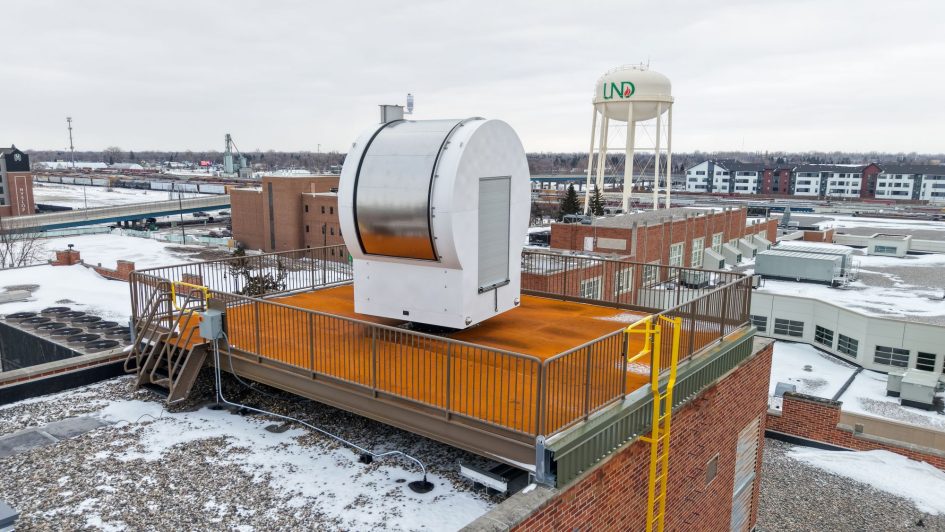
UND’s Free-Space Optical Communication Lab within Witmer Hall is a first-of-its-kind facility designed to communicate with satellites using laser technology. The project combines a temperature-controlled laser laboratory in the basement with a rooftop observatory and telescope capable of transmitting and receiving laser signals through space. Bridging those two worlds required the advanced physics expertise of UND, and the creative, precise structural engineering of AE2S.
Solving Challenges Along the Way
AE2S provided comprehensive structural engineering services for this unique project, supporting UND from early investigation through construction. From the outset, the focus was on listening first and understanding the constraints, goals, and long-term vision for the facility. One tangible outcome of the early planning was an idea developed by AE2S to design and construct the rooftop observatory structure as a single unit capable of being moved to the future STEM complex or to simply re-roof Witmer Hall.
An early challenge was simply understanding what was already there. In addition to site visits for visual assessment, AE2S used 3D scanning technology to capture the interior space and create a detailed point cloud of existing obstructions. That information became the foundation for a 3D BIM model of the penthouse, including the existing air handling unit and major ductwork. The model allowed AE2S and UND to explore layout options, identify conflicts early, and coordinate solutions before construction began. UND concurrently measured the natural frequency of the existing reinforced concrete structure, which was found to be exceptionally free of vibrations that could influence the function of the laser communications.
The placement of the telescope’s exterior enclosure and the interior stair access was carefully coordinated to avoid conflicts within the building while supporting the precision required for laser-based satellite communications.
Design for Evolving Needs
The support framing introduced the potential for snow drifting on the roof, a typical concern in North Dakota’s climate. Most challenging were the serviceability constraints of the telescope support framing. The structural serviceability (i.e., permissible movements) limits were presented in astronomical-based units of angular rotation (arc seconds) which were resolved to traditional structural units (inches of sag) to facilitate quick evaluations. Meeting the limits required very stiff framing, the use of fixed end coupler beams to transmit rotational loads to multiple beams, and direct fastening to the underlying concrete structure.
The final construction documents included structural plans and details, general notes, site plans and crane staging and loading notes to support competitive bidding, and a means to lift the entire support assembly and telescope as a single platform without any disassembly.
As UND’s needs evolved, the project adapted alongside them. AE2S evaluated the placement of a dry cooler unit on the main roof, reviewing the existing concrete framing system and detailing a new roof curb. When the telescope enclosure unit selected for the project changed, AE2S revised framing plans and anchorage details to accommodate both the new unit and the possibility of future reroofing or relocation.
Going Beyond
Beyond design, AE2S supported UND through procurement, assisted with bid evaluation, provided technical support during construction, and completed a final inspection and punch list. This continuity helped ensure the highly coordinated work aligned with project goals and performance requirements.
Once fully operational, this facility will become a rare, hands-on environment where students and researchers can work directly with laser-based satellite communications technology. The combination of a vibration-isolated basement lab and a rooftop telescope will prepare students for careers in space systems, communications, and optics. It also supports industry and government partners by building local expertise for a field that is rapidly evolving. Projects like this matter because they bridge education, research, and real-world application, creating opportunities that extend well beyond the campus.
For AE2S, the project reflects something broader: the ability to apply structural engineering fundamentals to unconventional challenges, collaborate across disciplines, and help turn ambitious ideas into reality.